fft_float: windowed floating-point FFT/IFFT#
New · AMD UltraScale+
Floating-point accuracy, FPGA throughput, any window you want. fft_float is a run-time configurable FFT/IFFT core that computes in IEEE-754 single precision from input to output, with a fully programmable window and up to 50% input overlap.
FP32 IEEE-754 single precision, end to end
277.8 MHz on Kintex UltraScale+, -1
Any window shape, loadable at run time
Overview#
fft_float is a run-time configurable FFT for AMD UltraScale+ FPGAs. The transform length can change on every frame, from 64 points up to the device’s memory limit; the reference build supports 32K points. The window is fully programmable: any shape can be loaded as N floating-point coefficients through its own port and clock, and reloaded between frames.
Because the arithmetic is floating point throughout, there is no scaling schedule to choose and no overflow to manage, and the dynamic range is that of single precision at every stage. The number of parallel butterflies is a build option, so the same design runs from a compact 4-butterfly core to a 16-butterfly high-throughput core.
Block diagram#
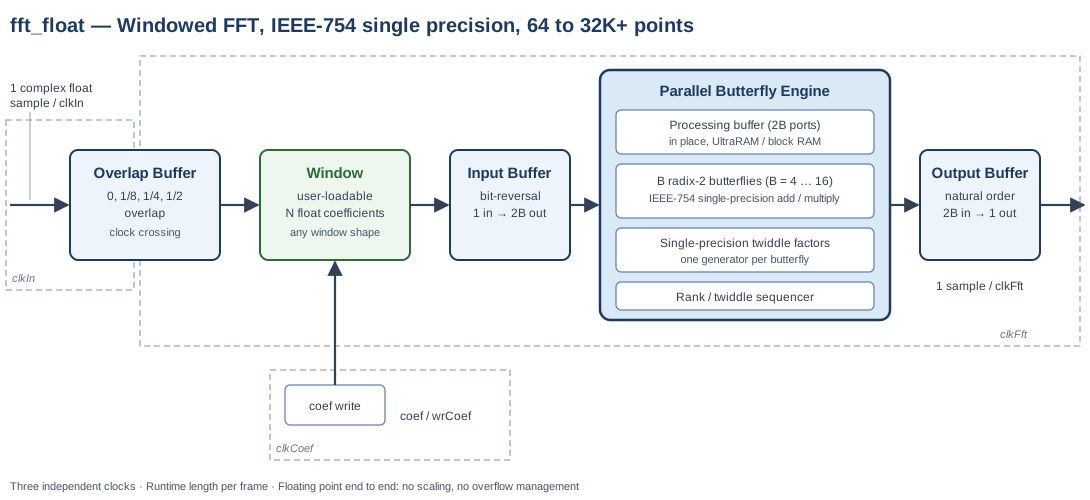
Signal flow through fft_float, with its three clock domains.#
- Overlap buffer
Accepts one sample per input clock, keeps the tail of the previous frame and builds each overlapped frame. It also moves the data into the processing clock domain.
- Window
Multiplies each sample by its coefficient from a coefficient RAM loaded by the user.
- Input buffer
Reorders the frame into bit-reversed order and widens it to 2B samples per clock for the engine.
- Parallel butterfly engine
B single-precision radix-2 butterflies process each rank in place. It is the same engine architecture as the fixed-point fft_64k: overlapped 64K-point FFT/IFFT.
- Output buffer
Returns the result in natural order, one sample per clock.
Features#
IEEE-754 single-precision complex data in, out and at every rank
Single-precision twiddle factors
AMD floating-point add and multiply operators, configurable pipelining
No scaling schedule and no overflow handling
Any window shape: N single-precision coefficients
Loaded through a simple write port (pointer reset plus write strobe)
Own clock domain; reload between frames
Applied to the overlapped frame, ahead of the transform
Length selected per frame, 64 points up to the build maximum (32K in the reference build; larger maximums limited only by device memory)
Overlap per frame: 0, 1/8, 1/4 or 1/2; only new samples are supplied
FFT or IFFT selected per frame
Parallel radix-2 butterflies set at build time (built with 4 and 16)
Three independent clocks: input, processing/output, coefficient load
Processing clock can run faster than the input clock for higher overlap
Natural-order output, one complex sample per processing clock
Performance#
Reference build: 4 butterflies, 32K maximum length, Kintex UltraScale+ KU5P, -1 speed grade (the slowest). Processing clock 277.8 MHz, timing met.
The engine takes about \((N/2B)\log_2 N\) processing clocks per frame, and the output takes \(N\) clocks; a frame needs the larger of the two.
Transform length |
Engine time (B = 4) |
Frames/s, back to back |
|---|---|---|
1,024 |
~1,280 clocks, 4.6 µs |
~217,000 |
4,096 |
~6,144 clocks, 22 µs |
~45,200 |
16,384 |
~28,672 clocks, 103 µs |
~9,690 |
32,768 |
~61,440 clocks, 221 µs |
~4,520 |
Maximum sustained input rate#
4 butterflies, 277.8 MHz processing clock:
Transform length |
Overlap 0 |
Overlap 1/4 |
Overlap 1/2 |
|---|---|---|---|
1,024 |
222 MSPS |
167 MSPS |
111 MSPS |
4,096 |
185 MSPS |
139 MSPS |
93 MSPS |
16,384 |
159 MSPS |
119 MSPS |
79 MSPS |
32,768 |
148 MSPS |
111 MSPS |
74 MSPS |
These rates are calculated from the processing clock and the engine timing, not measured.
For example, with the input clock at 1/4 of the processing clock (69.4 MSPS of continuous input), the most demanding case, 32K points at 1/2 overlap, uses 61,440 of the 65,536 processing clocks available per frame. So even with only 4 butterflies, the full overlap range is supported at the longest length. More butterflies raise the engine rate proportionally: with 16, the engine is four times faster and the core is limited by its output, at about one sample per processing clock, for most lengths.
Device utilization#
4 butterflies, 32K maximum length, single precision. AMD Kintex UltraScale+ xcku5p-ffva676-1-e, Vivado 2025.2.1, post-route. Timing met at 277.8 MHz.
Resource |
Used |
Available |
Utilization |
|---|---|---|---|
CLB LUTs |
9,478 |
216,960 |
4.4% |
CLB registers |
16,587 |
433,920 |
3.8% |
Block RAM (36 Kb) |
145 |
480 |
30.2% |
UltraRAM |
24 |
64 |
37.5% |
DSP48E2 |
84 |
1,824 |
4.6% |
Scaling with butterfly count#
Same device and settings, as an example of how resources grow with throughput:
Resource |
4 butterflies |
16 butterflies |
Per added butterfly |
|---|---|---|---|
LUTs |
9,478 |
32,955 |
~1,960 |
Registers |
16,587 |
54,173 |
~3,130 |
Block RAM (36 Kb) |
145 |
276 |
~11 |
UltraRAM |
24 |
64 |
~3.3 |
DSP48E2 |
84 |
324 |
20 |
The 16-butterfly, 32K build uses all 64 UltraRAMs of the KU5P; longer lengths or more butterflies at 32K need a larger device.
Fixed or floating?#
fft_64k: overlapped 64K-point FFT/IFFT (fixed point) |
fft_float (floating point) |
|
|---|---|---|
Arithmetic |
24-bit fixed (12 to 32 bit) |
IEEE-754 single precision |
Length |
64 to 64K |
64 to 32K (device-limited) |
Overlap |
up to 3/4 |
up to 1/2 |
Window |
none |
programmable |
Butterflies |
32 |
4 to 16 (build option) |
Input rate |
275 MSPS, continuous |
see the sustained-rate table |
Clocks |
1 |
3 independent |
Scaling |
per rank, per frame |
not needed |
KU5P use |
44% LUT, 76% block RAM |
4% LUT, 30% block RAM (4 butterflies) |
Deliverables#
Synthesizable RTL source
Bit-accurate Octave model of the complete processing chain
Self-checking testbench that verifies the window output, the bit-reversed input, the FFT engine output and the final output against the model
Simulation and synthesis scripts
User guide
Applications#
Spectral analysis where wide dynamic range matters: radar, sonar, radio astronomy, test and measurement
Algorithms developed in floating point (GPU or CPU heritage) moved to an FPGA with no fixed-point conversion or scaling analysis
Windowed, overlapped spectrum estimation (Welch method) with application-specific windows
Frequency-domain processing where the window must change at run time
Availability and licensing#
fft_float is available immediately under a project license. Contact us with your transform lengths, overlap, window and target device for pricing.